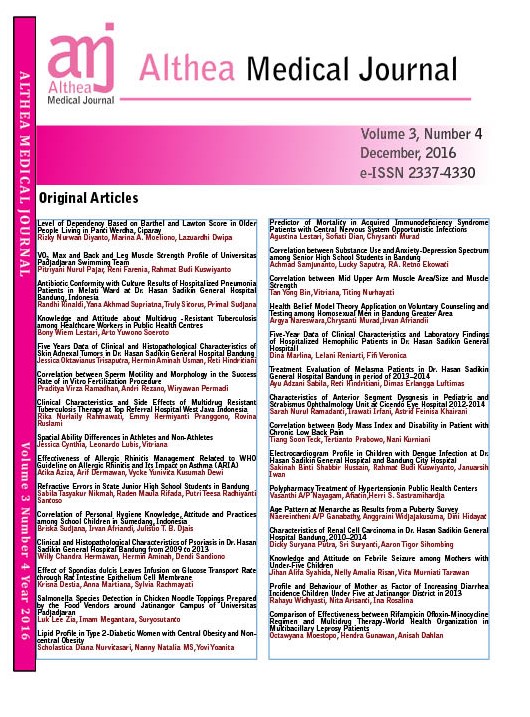
Effect of Spondias dulcis Leaves Infusion on Glucose Transport Rate through Rat Intestine Epithelium Cell Membrane
Keywords:
Antihyperglycemic effect, glucose transport rate, Spondias dulcis leavesAbstract
Background: Nowadays, people consume herbal remedies made from plants which are believed to be able to relieve certain symptoms and restore normal metabolic functions. Golden apple (Spondias dulcis) leaf has the potential to lower blood glucose. The purpose of this experiment was to observe the anti–hyperglycemic effect of S. dulcisleaves infusion on glucose transport rate through intestinal mucosal membrane of Wistar rats.
Methods: An experimental study was conducted from October 2013 to November 2014. Nine male Wistar rats were selected aged 12–16 weeks, weighted 250–400 grams, healthy, actively moving, and had never been used in experiments. The rats were anesthetized, cut open and given three kinds of treatments: three kinds of glucose solutions were flowed through the intestinal tract using in situ perfusion method. Samples obtained from the rat’s intestine were measured with a spectrophotometer to obtain glucose rate transported through intestinal membrane from every treatment. The results of condition 1 and 2, and condition 1 and 3 were then compared.
Results: The means of glucose transported through rat intestines epithelium cell membrane were 6.43 mg/dl, 9.40 mg/dl and 9.81 mg/dl. Statistic test result showed there was no significant difference on the glucose transported in every treatment.
Conclusions: Glucose absorption rate in rat intestine doesnot decrease after they are given S. dulcis leaves infusion. Therefore, this experiment concludes that S. dulcis leaves do not affect the glucose transport rate in rat intestines epithelium cell membrane. [AMJ.2016;3(4):562–5]
DOI: 10.15850/amj.v3n4.939
Downloads
Published
Issue
Section
License
- Authors retain copyright and grant Althea Medical Journal right of first publication with the work simultaneously licensed under a Creative Commons Attribution License that allows others to freely share and remix the work with an acknowledgement of the work's authorship and initial publication in Althea Medical Journal. Althea Medical Journal is licensed under CC BY-NC 4.0
- Authors are permitted to copy and redistribute the journal's published version of the work non-commercially (e.g., post it to an institutional repository or publish it in a book), with an acknowledgment of its initial publication in Althea Medical Journal.